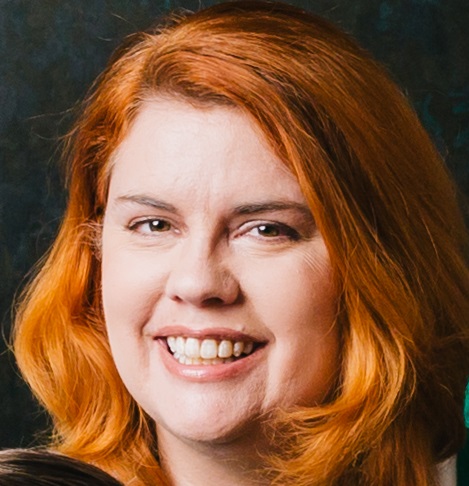
 When people ask “where did you grow up?” I have to answer “pick one.” My family moved often enough that I can call a lot of places home, including Oregon, Washington State, Colorado, New York State, Arizona, and Texas. I’ve lived in Utah for fifteen years now and I have children who’ve never known a home anywhere else.
Throughout all those moves, reading has been a constant in my life, and even now I remember places based on what I was reading at the time: the Dragonriders of Pern books in New York, the Foundation series in Texas, Crown Duel in Utah. I’ve worked as a librarian twice, once as a shelver in the public library and once supervising the collection of a small private school, both of which taught me a lot about people’s reading habits and how to match the perfect book with its perfect reader.
I never thought to write fiction until a few years ago; I studied young adult literature in college and went on to write literary essays and reviews for many years. I had the idea for my first book, EMISSARY, and just for fun decided to see if I could turn it into a novel. It was hard, and exciting, and more fun than anyone ought to be allowed to have, so I kept at it. I’m always in the process of writing something new, and I love the joy of starting a new project.
When I’m not writing or reading, I’m spending time with my family binge-watching anime shows or playing Arkham Horror. I also do some costume sewing, jewelry making and repair, and paint fantasy miniatures for whatever role-playing game I’m currently part of. I’m a terrible cook and a worse gardener, and I live with four cats, all of them extremely needy.
Just finished stormwatch citidel. You have the most amazing settings for books and twists in them. Any advice for a new writer?
Just finished stormwatch citidel. You have the most amazing settings for books and twists in them. Any advice for a new writer?
Thank you! I’m glad you liked it.
There are a lot of things I could tell a new writer, and I’m not sure which is most important, so this is in order as I think of them. One is to read widely, both in your genre and outside it. Reading teaches you the rhythms of writing, the structure of plot, and shows you interesting characters.
Another is to write what you love. People will say “write what you know,” but in the internet age, you can learn enough about practically anything to make your stories sound plausible. Instead, choose topics and settings and characters that you really care about, because that love will come through to readers.
There will be a lot of people who want to tell you “the rules” of writing. It’s important to figure out how those rules work so you will know when you can break them and how. If anyone gives you advice that includes the words “always” and “never,” consider carefully whether or not that applies to you.
That said, find someone (or a couple of someones) who can read your work and provide honest feedback. Writing groups can do this, but more than half the time they fall apart and don’t benefit you in the long run. A good first reader or handful of beta readers is an invaluable asset.
And–all right, this might be most important–write as often as you can. You don’t necessarily have to write every day, but you need to not let other considerations get in the way of your writing, or you’ll end up never starting. Pick a time of day you can set aside for your writing and then guard that time. It may take a while for you to figure out what that time is, so experiment. My best writing time is between 9 a.m. and noon, though I can write at other times. That’s just the one where I don’t let other stuff get in the way if it’s not an emergency. Remember that to be a writer, you really do have to write. 🙂
I hope that’s helpful. Good luck!
I just finished the last warmaster book. It’s awasome thank you for writing it. How do you make such a satifiying charater ark?