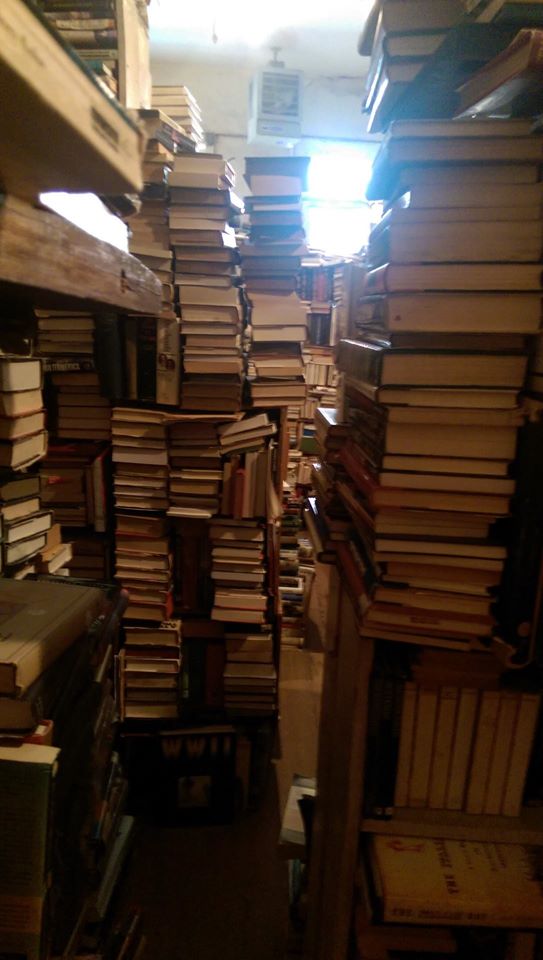
My next book, THE BOOK OF SECRETS, is coming out in January. This first book in the new series The Last Oracle is the story of a young woman whose new job as clerk in a mysterious bookstore turns out to be more than she could have imagined. Here’s a look at the first chapter:
The Book of Secrets, Chapter One
Bookstores were supposed to smell of old leather and dry paper. This one smelled of onion, of musty dry air trapped for centuries underground, smells that hung in the frigid air like invisible curtains. Aside from my own breath, the store was perfectly still, without even the whoosh of passing traffic to remind me of the world outside.
I took a few steps toward the bookcases, peering around them for some sign of Mr. Briggs. Should I wait for him, or did he expect me to follow while he answered the phone? I’d had exactly three job interviews in my life, not counting the one that had gotten me the job at McDonald’s the summer I was sixteen, and I had no idea what the protocol was. My shoes, sensible pumps, tapped quietly across the cracked yellow linoleum, spangled with silver stars that time had worn to gray blisters. Still no sign of life.
I straightened my skirt and took a seat on the folding chair next to the door. I stifled a shriek when my bare legs brushed the freezing metal. The chair wobbled when I shifted my weight, and I held still, afraid it might dump me off. I really didn’t want to touch the floor. It wobbled again, and I shot to my feet. Maybe standing was the better option.
The wooden counter to my left was curved plywood stained walnut-dark, topped with a sheet of glass cracked like the linoleum. A stack of remaindered pop psychology books declaring I could Master My Potential! weighed it down at one end, and the antique cash register took up the other. It looked more like an art piece than anything functional, with brass filigree decorating its sides and back, and a Victorian valentine complete with lace appliqued to the top. It was hard to believe it was anything more than a conversation piece, but I’d seen Mr. Briggs use it when handling a sale ten minutes ago, so it wasn’t a joke.
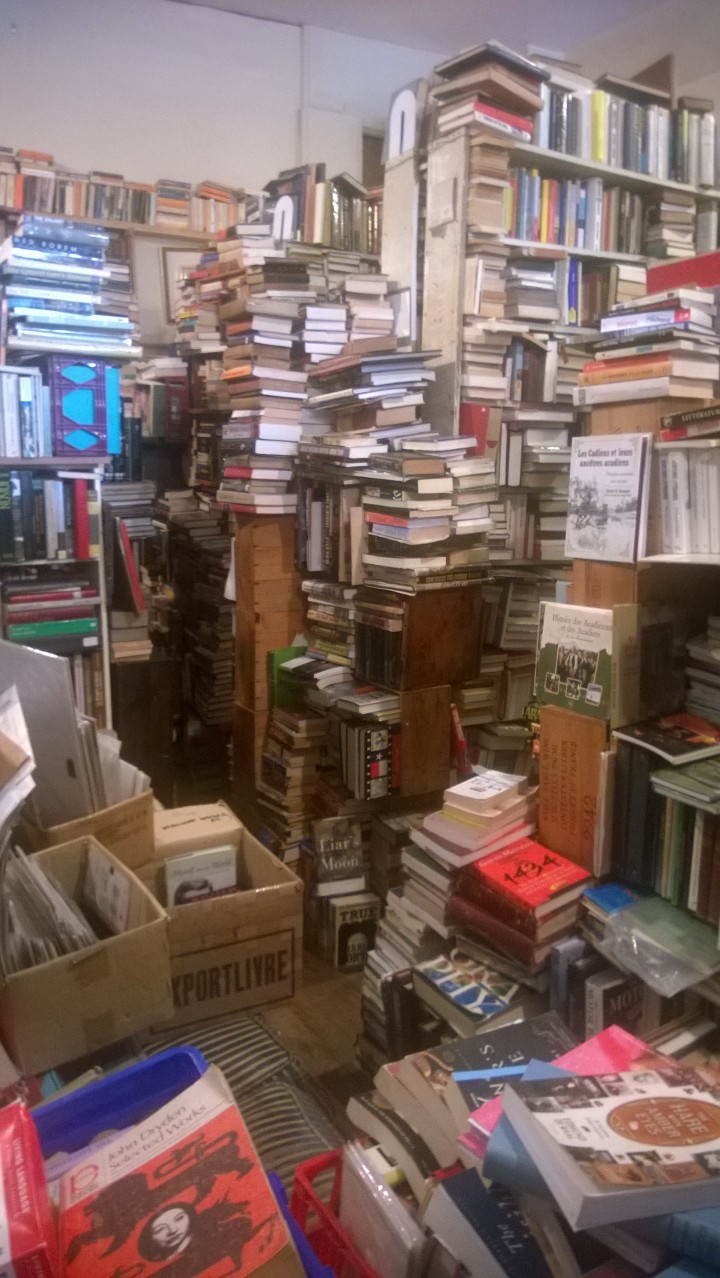
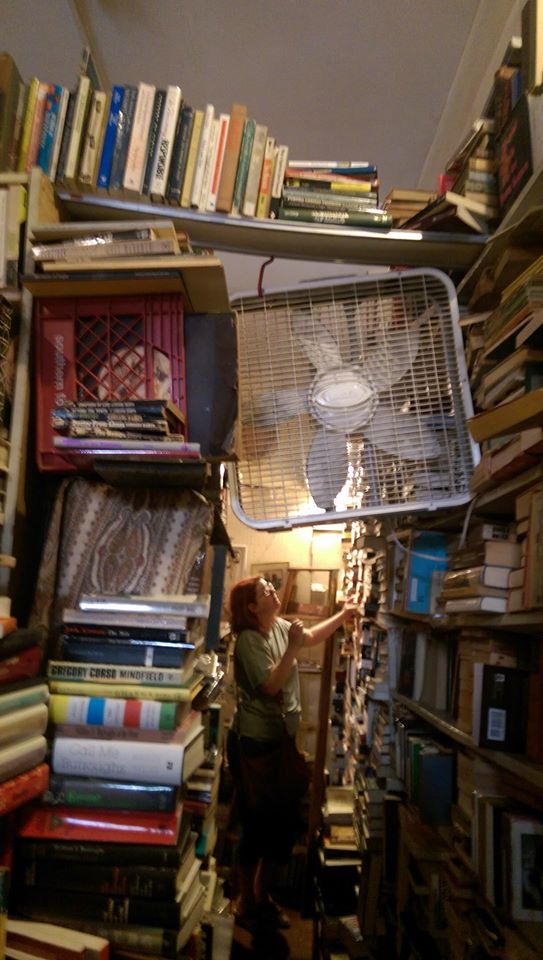
It had been a surprise when someone actually bought a book. I didn’t think anyone was brave enough to squeeze between the shelves. They were packed so tightly that if two people tried to negotiate the same aisle, one would have to back up to let the other pass. The highest shelves were well beyond the reach of an ordinary person, at least eight feet tall, and I hadn’t seen a stepladder. And the books… it made me shudder to look at them, crammed in any old way, flat on their faces or standing at attention, with more books piled on the tops of the bookcases. The idea of this going on for several hundred square feet gave me chills.
I went to the nearest bookcase and examined the titles. There was no theme to their organization: a cookbook sat next to a book on the Prussian military campaign in 1805, which was next to a novel titled Translations in Celadon. I removed a book and sniffed its spine. It smelled just as it ought, of dry paper and dust, and that reassured me. The store might be strange, the organization nonexistent, but at least the books were sound. I’d half-expected to smell mildew or cigarette smoke.
I heard a distant voice, barely more than a whisper. “Hello?” I said. “Mr. Briggs?” The whispering stopped. A draft of frigid air brushed my ear, making goose pimples rise up on my arms. The voice spoke again, but I still couldn’t understand it. I turned around fast, suddenly nervous that someone had managed to come in without my hearing them. No one. Either my imagination was piqued by my unusual surroundings, or the store was haunted. By the onion-scented ghost of a former owner, no doubt.
Heavy footsteps sounded, and I quickly put the book back and sat in the chair. “Sorry,” Mr. Briggs said. He was a short man with a paunch and a yellowish, jaundiced cast to his skin, wearing gray slacks and a blue and gray argyle sweater vest over a white button-down shirt. A pair of very old-fashioned half-moon glasses perched on his blond head, apparently forgotten. “A long-time customer. We try to keep them happy, of course.”
“Of course,” I said, wondering at “we.” Mr. Briggs, as far as I could tell, ran the shop alone. It was why I was there. “Do you do a lot of business online?”
“Not online,” Mr. Briggs said. He pulled a metal stool that looked like the distant cousin of my chair around from behind the counter and sat, drawing his feet up to rest on the lower rung. “We deal strictly in the catalogue trade. Most of our customers don’t use the internet at all.”
“I see,” I said, though I didn’t, really. “So… phone calls, order forms…?”
“Exactly. And walk-in customers. We don’t get as many of those these days. The neighborhood hasn’t exactly gone downhill, but much of the foot traffic has been diverted west. People have to make an effort to reach us, which is probably to the good.”
No organization. No customers. No desire for customers. And the place smelled strange. I clasped my hands in my lap, atop my purse. I ought to leave, thank him for his time and say I didn’t think I was a good fit. But that would be rude. “I wasn’t quite clear on the job description,” I said. “What would my—the duties be?”
“Cash register, of course,” Mr. Briggs said. “Stocking new inventory. Filling catalogue orders. Light cleaning. Then there’s the opportunity to move up to customer relations. It’s not very demanding work, but you’d start at fifteen dollars an hour and work your way up from there.”
Fifteen. That was almost half again what I could make at the Pick ‘n’ Pack, which was my only other job lead so far. “It sounds interesting,” I heard myself say.
“Then it’s settled. How do you feel about starting now?”
I gaped. “Ah… don’t you want to interview me?”
“No need. Your resume is exactly what we’re looking for.”
“But…” I felt, perversely, as if I should talk him out of it. “My resume is practically empty.”
“Which means you don’t have any bad habits to unlearn.”
“That can’t be a solid basis for hiring someone!”
“It isn’t.” Mr. Briggs took his glasses off his forehead and settled them firmly on his nose. “But our other criteria won’t matter to you.”
“I think I have a right to know what my qualifications are.”
“All right. You’re punctual, you’re quiet, and you know how to type. Do you want the job or not?”
I wobbled on the chair again. “I do.”
“Then I’ll show you where you can put your things, and you can get started.” Mr. Briggs stood and moved the stool back behind the counter. “Do you have any questions?”
I had so many questions I felt choked with them. Naturally, I came out with the most irrelevant one. “Abernathy’s. The store. Who’s Abernathy?”
Mr. Briggs smiled, making his cheeks puff up like a blond chipmunk’s. “An excellent question,” he said, and moved off into the stacks without saying anything more. I stood unmoving, confused, for a few seconds before remembering I was now an employee and shouldn’t stand around gaping.
Mr. Briggs showed me the tiny room, barely more than a closet, that in any other store I would have called a break room. It contained a small folding table and a couple of those freezing metal chairs, a wooden coatrack with two of the pegs sheared off, and a miniature refrigerator and microwave. I reluctantly hung my coat on one of the remaining pegs—the place was still bitterly cold—and followed Mr. Briggs to the room opposite, which turned out to be his office. Stacks of cardboard boxes full of glossy catalogues stood waist-high against the far wall, tilting haphazardly against one another.
Mr. Briggs sat in a rolling office chair and leaned over to open the bottom drawer of the tan melamine and chrome desk. “This is the employee agreement,” he said, coming up with a single sheet of paper. “We’ve never seen the point of a lot of paperwork. Read it first, if you want, but it’s fairly basic. Then you sign here and here.” He pushed the phone, putty-colored and older than I was, out of the way to lay the paper on the desk.
I read the document, which was handwritten in green ink. Abernathy’s wasn’t interested in my address, my Social Security number, my mother’s maiden name, or anything else. There were just a few paragraphs outlining the job description Mr. Briggs had given me, a few more paragraphs in which I asserted that I wasn’t a felon or a drug dealer, and then, bizarrely, a line that read I, _______ , swear to uphold the standards of Abernathy’s without fear or favor, and to seal its secrets in my heart, for as long as it remains in my charge.
“What does this mean?” I asked.
“It means you won’t disclose confidential information about our patrons,” Mr. Briggs said. He had his eyes fixed on the document, not on me, and his fingers drummed restlessly on the melamine. I hesitated. “Is there a problem?”
“… No. No problem.” I signed with the leaky plastic ballpoint he handed me, then gave pen and paper back to him and watched him countersign on the line below my signature.
He folded the paper in thirds and rolled backward to put it away in the top drawer of the filing cabinet. Then he unlocked the desk’s middle drawer with a small brass key and opened it. “Mailing list,” he said, handing me a sheaf of paper. “We send out a catalogue three times a year. You’ll type the labels, address the catalogues, and have them ready for me to take to the post office tomorrow morning.”
“All right,” I said. The list was ten pages long and the addresses written in a cramped, faded hand. “Where’s the computer?”
“No computer. We don’t have any need for them.” Mr. Briggs indicated a smaller desk behind his own. On it was an electric typewriter in a pebbly beige case. I’d seen ones like it before. In a museum. “There are labels in a box in the filing cabinet. Let me know if you need anything else.”
When he was gone, I took a catalogue from the topmost box and flipped through it. The glossy, slick cover had a blurred photo of the storefront under the name ABERNATHY’S. Someone stood next to the front door, possibly Mr. Briggs, though the photo was blurry enough it was impossible to tell.
Inside, there was no table of contents; lines of tiny print spread neatly in two columns across gray recycled paper. I ran my finger down the columns, accidentally smearing the cheap ink. I didn’t recognize any of the titles, which weren’t in alphabetical order. Some catalogue. I dropped it back into the box and regarded the antique typewriter with a sigh. All right, it wasn’t all that antique, but forty years old was still old enough to qualify. I wasn’t even sure I knew how to use it.
I found the labels and some blank white paper in one of the drawers of the filing cabinet. I practiced for a bit with the paper until I had the hang of the thing, then inserted the labels and started typing. For all the handwriting was crabby and small, it was easy to read, and I soon fell into a rhythm that let my brain wander pleasantly, far away from this store that smelled of onion.
My parents would be thrilled I’d gotten the job, though they’d be just as thrilled if I was working at the Pick ‘n’ Pack. What they wanted was for me to be employed, period, so I’d move out of their basement and become a responsible adult. Not that they were as blunt about it as that. They’d been generous in letting me pay rent and some of the grocery bill, and never nagged me about my future. I was lucky, really.
I came to the end of a sheet of labels and inserted a fresh one. My mind wandered away again. I was twenty-one years old; you’d think I’d have some idea what I wanted to do with my life. But I’d graduated from high school without making much of an academic splash, had made it through a couple of years of community college before the money ran out, and now… Well, this wasn’t the best job in the world, but if I could stick it out, maybe get a raise—did Mr. Briggs offer benefits?—I might, at some point, come close to having a clue about my future.
I heard whispering again, and turned around fast, knocking the list to the floor. Nothing. I got up and opened the door. The hall outside was empty. I shut the door again and shook my head. I was being stupid. Just because the bookstore and Mr. Briggs were a little weird didn’t mean I had to let my imagination come up with more weirdness. I was level-headed and not superstitious, and I was wasting time.
The mailing list had fallen splayed-out on the floor. I leaned over to pick it up, and a wave of dizziness struck me. For a moment, the room was outlined in flickering blue light. Then it passed, and I sat clutching the list in both hands. That had been strange. I bent over and sat up again, but felt nothing but a brief pressure as the blood rushed to my head and away again. The room looked perfectly normal. Shrugging, I spread out the mailing list again and resumed typing. I could ask Mr. Briggs… and have him decide his new employee was mentally unstable. It could stay a mystery.
By the time I reached the end of the mailing list, I was starving. I checked my watch. 1:17. I hadn’t brought any food because I hadn’t expected to start work immediately. There was a market around the corner. Mr. Briggs had to give me some sort of lunch break, right?
Mr. Briggs was gone when I left his office. I checked the break room and knocked tentatively on the washroom door; both were empty. I quickly used the toilet, which was as ancient as the typewriter, probably had one of those 3.5 gallon tanks that weren’t legal anymore, washed my hands, and ventured into the bookstore proper. Most of the bookcases were knocked together out of plywood and lengths of unfinished yellow 2x8s, though there were a few proper cases of polished, chipped oak and two blackish-brown units that came from IKEA. I sidled between them, unwilling to call out Mr. Briggs’ name into the silence of the store. The hush was so profound I imagined the books were sleeping.
Just as I’d begun a reverie about putting books down for a nap and imagining what kind of lullabies they would prefer, I heard the door open, then slam shut with such force it rippled through my skin. That couldn’t possibly be Mr. Briggs. I hurried to the front of the store, feeling a sidelong sense of responsibility at being, as far as I could tell, the only Abernathy’s employee on site. Then I felt embarrassed at my reaction. It was a store. People were supposed to come in and browse, Mr. Briggs’ odd notions to the contrary. Even so, I probably shouldn’t give anyone ideas about shoplifting.
The man was standing next to the counter when I emerged from the maze of bookcases, as if he’d been waiting for me. In his three-piece pinstriped suit, handstitched leather shoes, and heavy gold watch, he looked as out of place in Abernathy’s as a computerized cash register would be. He was studying his watch, but looked up when I arrived, and I felt caught by his dark-eyed gaze, pinned to the nearest case like a captive butterfly. “Who are you?” he said, somewhat irritably.
“Helena Davies. I started work this morning.” I immediately wished I hadn’t sounded so defensive.
Irritation gave way to surprise. “Nathaniel hired you? Impossible.”
I swallowed a sharp response. The customer is always right, especially when he could probably buy this whole store twice over. “Can I help you with something?” I said, hoping he’d say no, because the only help I was capable of giving was directions to the toilet, which wasn’t for public use.
“I doubt it,” the man said. “Who are you?”
I regarded him more closely. He was good-looking, with fashionably styled dark hair, and no more than thirty, but he had an air about him that would have better suited an octogenarian with a Napoleon complex. “I don’t know why you’re so sure I don’t belong here, but I’m certain I signed an employment contract,” I said, trying not to think about how irregular the paperwork had seemed. “Maybe I should go get Mr. Briggs.”
“You do that,” the man said. “Nathaniel must be in the basement. Why don’t you bring him here, and I can convince him to be sensible.”
“I don’t know—” I shut my mouth. I felt I’d already told this man too much. “Please wait here,” I said, and backed away. Turning my back on him made me nervous.
I hadn’t realized there was a third door beyond the office and the break room. It was flat plywood, stained dark like the walls of the short hallway, with an iron knob that looked like a black knot against the wood. I opened it to find stairs descending into perfect blackness. A string swayed in the faint breeze of the opening door, and I tugged on it, lighting a single dim bulb that didn’t do much more than set shadows moving.
The steps were raw wood, splintered on the edges except where hundreds of feet had worn them smooth. They didn’t creak under my weight, to my surprise; I’d almost expected the cries of the damned with every step. At the bottom of the stairs, there was a light switch. I flipped it on, and a couple of fluorescent bulbs flickered into life. They cast a brilliant light over the small, cold basement with its dark concrete floor. I looked down, and screamed.
Mr. Briggs lay face down a few feet from the foot of the stairs. Dark blood spread across the back of his argyle sweater and pooled beneath his chest and head. I stumbled forward and knelt beside him, scraping one knee on the cold concrete. His eyes were closed, and I fumbled at his throat for a pulse. I didn’t know how to find a pulse. I didn’t know how to do any of the things you were supposed to do to see if someone was alive. I leaned far forward, holding my hair out of the way, and put my cheek near his mouth. No warmth, no breath.
Someone thundered down the stairs. “Move back,” the strange man said. I scooted back, tugging my skirt over my knees, and watched the stranger crouch over Mr. Briggs and repeat the same movements I’d made. Finally, he stood up and put his hands on his hips. “Nathaniel,” he said. It sounded like a reprimand. As if Mr. Briggs was in trouble for being killed.
“What are you—we have to call the police!” I reached for my phone and came up empty. I’d left it in my purse—no pockets in this skirt. I felt my breath coming in quick, ragged pants and forced myself to stay calm.
“That would be a serious error,” the stranger said. “Starting with the fact that you’d certainly be their first suspect.”
I gaped at him, panic welling up again. “Are you crazy? Look, I don’t have any blood on me, I hardly touched him! There’s no reason to suspect me!”
“You were alone in the store with him, you are a new employee—you might have killed him to get at the contents of the cash box.”
“Then why would I stay around to call for help?”
The man sighed. “I’m not saying they’d convict you. I’m saying they would make your life hell for a while. Is that what you want?”
I looked at him, at his height and the way he stood, and felt more chilled even than the basement could account for. “I… think I’ll risk it.” I took a few casual steps toward the stairs, never letting my eyes leave his face.
“I didn’t kill him,” he said, exasperated. “I don’t have any blood on me either, do I? And I think whoever stabbed Nathaniel in the back would be at least a little bloody.”
“How do you know that’s what happened?”
He pointed. “There’s a gash in the back of his sweater. You can see where the blood collected there first and made the fabric curl. Look, whoever you are, you can’t be stupid or Nathaniel wouldn’t have hired you. Somebody came into the store and killed Nathaniel, and you’re damned lucky whoever it was didn’t realize you were here, or you’d have joined him.”
I sat down heavily on the second stair from the bottom, my vision clouding over. “They had to know I was here,” I said. “That typewriter isn’t quiet.”
“It’s not important,” the man said. “What matters is we need to get someone to take care of Nathaniel’s body. Someone who isn’t the police.”
“That’s insane. We have to tell the police. People don’t just ‘take care of’ dead bodies.”
“The police will draw far too much attention to this store. No, we’ll handle this matter privately. I’ll need your permission to—”
“My permission? What do you mean, ‘privately’? I’m calling the police.”
The man focused on me then, his attention an uncomfortable knuckle digging into the base of my neck. “What’s your name again?”
“Helena. Helena Davies.”
“And you’re certain Nathaniel hired you today?”
“Yes.”
“Well, Helena Davies,” the man said, his lips curving in a sardonic smile, “you’ve just inherited this bookstore.”